The WIP schedule and cash forecast your bonding agent keeps asking for.
Project Financials turns the draws, change orders and monthly costs your PMs already track into a cash-flow curve, a surety-format WIP schedule and a crew plan. Flat monthly price. No ERP, no implementation fee, no percentage of your revenue.
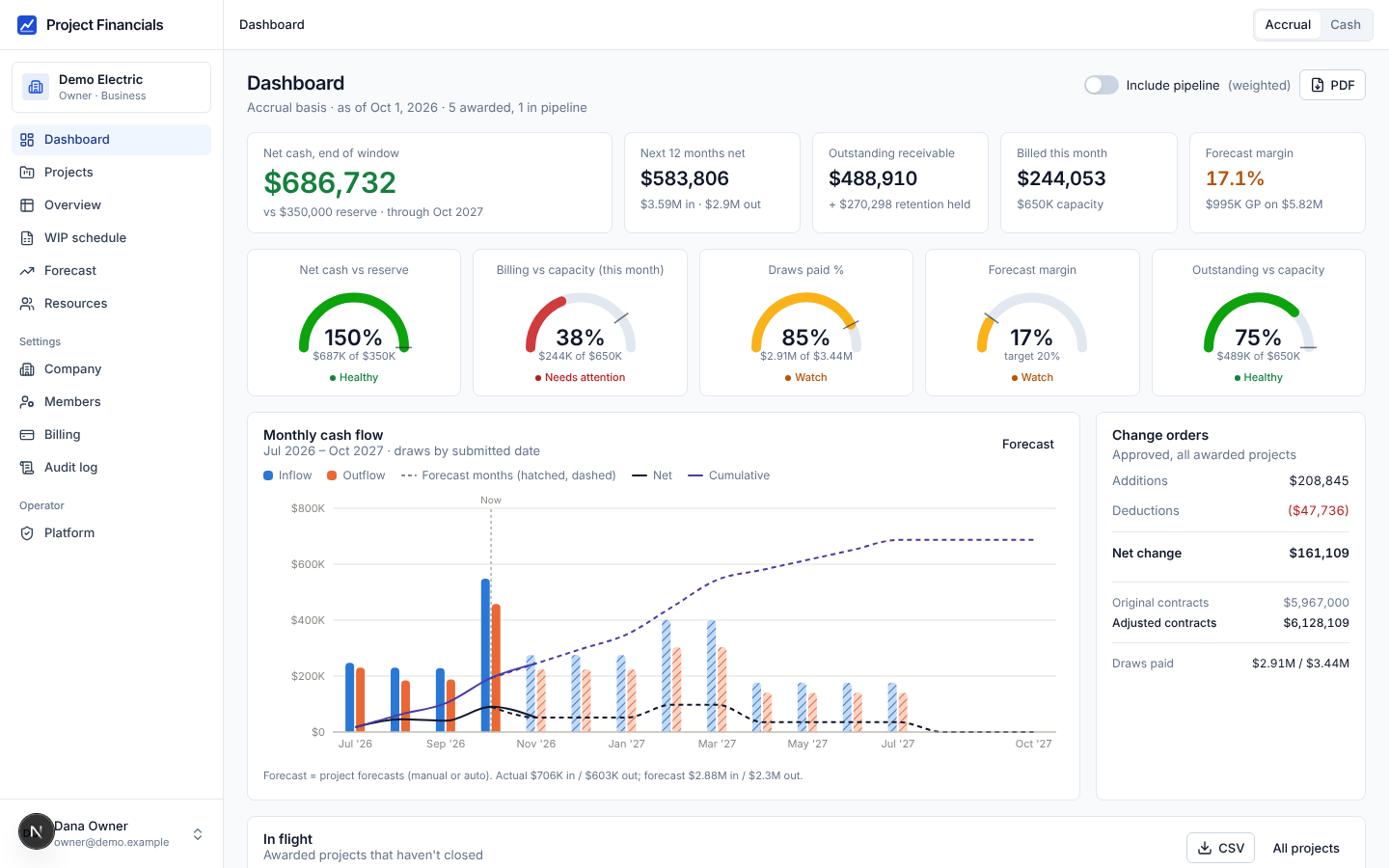
The company dashboard for a six-project electrical sub. Every number traces back to a draw, a cost line or a PM’s forecast.
Three questions every subcontractor gets asked, answered from numbers you already have.
Your banker, your surety and your CPA want the same three things each month. So does the owner, on a Sunday night.
Are we over- or under-billed?
Every awarded project gets a line on a real WIP schedule: adjusted contract, cost to date, estimated cost at completion, percent complete, earned revenue, and the over- or under-billing that comes out of it. Pick any as-of date. Freeze a snapshot at month-end and send it to your bonding company.
What does cash look like in six months?
Draws land in the month they are submitted or the month they are paid, your choice. Retention stays out of cash until it is released. Costs come in by month and category. Past the current month the curve switches to what your PMs forecast, and the dashboard checks it against the reserve you set.
Can we man the work we're bidding?
Each project carries a weekly allocation of people, trucks, lifts and tool kits. Pipeline work is weighted by its probability. Stack it all against the crew you can actually field and the weeks you are short show up in red, before you sign the next contract.
One place for the project numbers, from award to retention release.
- Projects and draws
- Contract value, schedule, pay-app draws with retention, overdue badges.
- Change orders
- Approved COs adjust the contract; pending ones are tracked but not counted.
- Costs by category
- Labor, materials, subs, equipment, overhead and other, month by month. Paste from Excel.
- Cash-flow curves
- Per project and company-wide, accrual or cash basis, actual plus forecast.
- PM forecasting
- Cost-to-complete owned by the project manager, with the source of every number shown.
- WIP schedule
- Full surety-format schedule with history, profit-fade flags and month-end snapshots.
- Dashboard and gauges
- Net cash vs reserve, billing vs capacity, draws paid, margin, receivables.
- Resource planning
- Weekly manpower, trucks, lifts and tool kits against company capacity.
- Roles and access
- Owner, admin, PM, field and viewer, with per-project access for the field.
- Exports and imports
- Excel and PDF for everything; import projects and cost grids from Excel.
A full WIP schedule, as of any date, that reads the way your surety reads it.
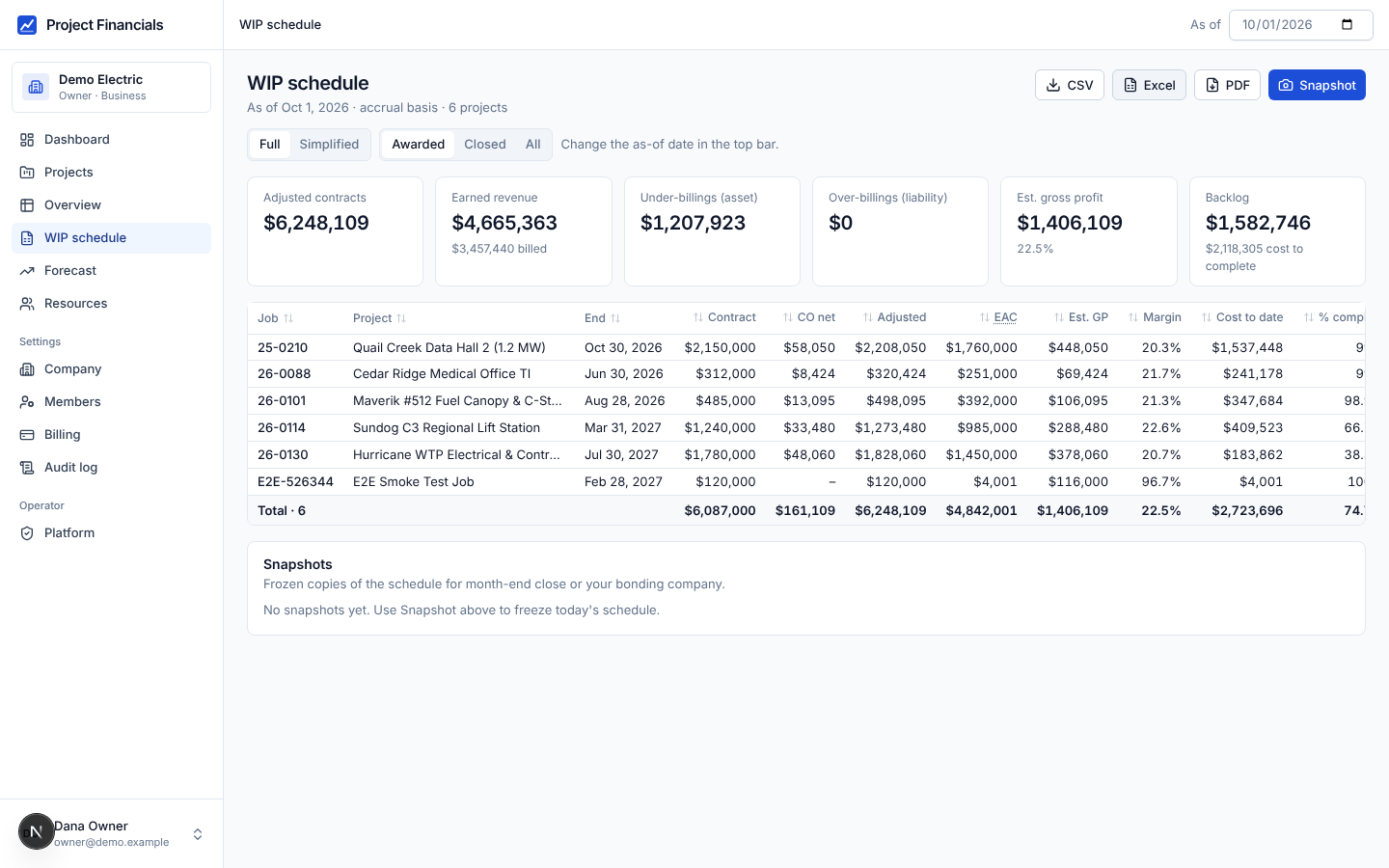
Full or simplified view, awarded or closed projects, Excel and PDF exports, and snapshots frozen at month-end.
Built by a contractor, not a software company.
Kevin Steed owns KRS Electric, a commercial and industrial electrical contractor in Utah. The company started in 2017 and has about forty people in the field. They wire fuel stations, medical buildings, small data centers, lift stations and water-treatment plants, the kind of fixed-price, progress-billed work where cash and retention decide whether the year is good.
Every month the same requests came in: the surety wanted a WIP schedule, the bank wanted a cash forecast, and the office wanted to know whether the next six months of awarded work could actually be staffed. The software that produces those reports was built for general contractors with a controller and an IT department, priced on revenue, and took the better part of a year to implement.
So Kevin built the tool his own company runs on: project-level cash flow, a real WIP schedule, PM-owned forecasting and a weekly crew plan, with nothing else bolted on. Project Financials is that tool, made available to other subcontractors at a price a forty-person shop can justify.
Flat per company. Never a percentage of what you bill.
Three plans, priced by active projects and users. Annual billing takes about 20% off. Every plan exports everything.
Starter
$99 / month
$79 / month billed annually
Up to 10 active projects, 3 users.
Professional
Most popular$249 / month
$199 / month billed annually
Up to 40 active projects, 10 users.
Business
$499 / month
$399 / month billed annually
Unlimited projects, 25 users.
Things owners ask before they start.
Is this an accounting system?
What does my team have to enter?
Will my bonding agent accept the WIP schedule?
How is it priced?
What happens to my data if I leave?
Produce your first WIP schedule this week.
Fourteen days, full Professional features, no credit card. Import your projects from Excel, enter the draws and costs you already have, and hand your bonding agent a schedule you can stand behind.